2021年1月9日 星期六

LeetCode 125. Valid Palindrome [Easy] [C++] 解題筆記

Given a string, determine if it is a palindrome, considering only alphanumeric characters and ignoring cases.

Note: For the purpose of this problem, we define empty string as valid palindrome.

Example 1:

Input: "A man, a plan, a canal: Panama"
Output: true

Example 2:

Input: "race a car"
Output: false

2021年1月7日 星期四

LeetCode 124. Binary Tree Maximum Path Sum [Hard] [C++] 解題筆記

Given the root of a binary tree, return the maximum path sum.

For this problem, a path is defined as any node sequence from some starting node to any node in the tree along the parent-child connections. The path must contain at least one node and does not need to go through the root.

Example 1:

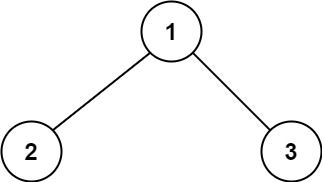
Input: root = [1,2,3]
Output: 6

Example 2:

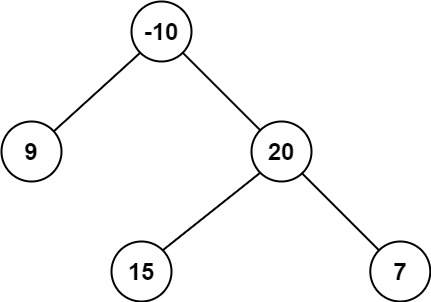
Input: root = [-10,9,20,null,null,15,7]
Output: 42

2020年11月3日 星期二

LeetCode 123. Best Time to Buy and Sell Stock III [Hard] [C++] 解題筆記

Say you have an array for which the ith element is the price of a given stock on day i.

Design an algorithm to find the maximum profit. You may complete at most two transactions.

Note: You may not engage in multiple transactions at the same time (i.e., you must sell the stock before you buy again).


Example 1:

Input: prices = [3,3,5,0,0,3,1,4]
Output: 6
Explanation: Buy on day 4 (price = 0) and sell on day 6 (price = 3), profit = 3-0 = 3.
Then buy on day 7 (price = 1) and sell on day 8 (price = 4), profit = 4-1 = 3.

Example 2:

Input: prices = [1,2,3,4,5]
Output: 4
Explanation: Buy on day 1 (price = 1) and sell on day 5 (price = 5), profit = 5-1 = 4.
Note that you cannot buy on day 1, buy on day 2 and sell them later, as you are engaging multiple transactions at the same time. You must sell before buying again.

Example 3:

Input: prices = [7,6,4,3,1]
Output: 0
Explanation: In this case, no transaction is done, i.e. max profit = 0.

Example 4:

Input: prices = [1]
Output: 0

2020年11月2日 星期一

LeetCode 122. Best Time to Buy and Sell Stock II [Easy] [C++] 解題筆記

Say you have an array prices for which the ith element is the price of a given stock on day i.

Design an algorithm to find the maximum profit. You may complete as many transactions as you like (i.e., buy one and sell one share of the stock multiple times).

Note: You may not engage in multiple transactions at the same time (i.e., you must sell the stock before you buy again).

Example 1:

Input: [7,1,5,3,6,4]
Output: 7
Explanation: Buy on day 2 (price = 1) and sell on day 3 (price = 5), profit = 5-1 = 4.
             Then buy on day 4 (price = 3) and sell on day 5 (price = 6), profit = 6-3 = 3.

Example 2:

Input: [1,2,3,4,5]
Output: 4
Explanation: Buy on day 1 (price = 1) and sell on day 5 (price = 5), profit = 5-1 = 4.
             Note that you cannot buy on day 1, buy on day 2 and sell them later, as you are
             engaging multiple transactions at the same time. You must sell before buying again.

Example 3:

Input: [7,6,4,3,1]
Output: 0
Explanation: In this case, no transaction is done, i.e. max profit = 0.

LeetCode 121. Best Time to Buy and Sell Stock [Easy] [C++] 解題筆記

Say you have an array for which the ith element is the price of a given stock on day i.

If you were only permitted to complete at most one transaction (i.e., buy one and sell one share of the stock), design an algorithm to find the maximum profit.

Note that you cannot sell a stock before you buy one.

Example 1:

Input: [7,1,5,3,6,4]
Output: 5
Explanation: Buy on day 2 (price = 1) and sell on day 5 (price = 6), profit = 6-1 = 5.
             Not 7-1 = 6, as selling price needs to be larger than buying price.

Example 2:

Input: [7,6,4,3,1]
Output: 0
Explanation: In this case, no transaction is done, i.e. max profit = 0.

LeetCode 120. Triangle [Medium] [C++] 解題筆記

Given a triangle, find the minimum path sum from top to bottom. Each step you may move to adjacent numbers on the row below.

For example, given the following triangle

[
     [2],
    [3,4],
   [6,5,7],
  [4,1,8,3]
]

The minimum path sum from top to bottom is 11 (i.e., 2 + 3 + 5 + 1 = 11).

Note:

Bonus point if you are able to do this using only O(n) extra space, where n is the total number of rows in the triangle.

2020年10月13日 星期二

LeetCode 119. Pascal's Triangle II [Easy] [C++] 解題筆記

 Given an integer rowIndex, return the rowIndexth row of the Pascal's triangle.

Notice that the row index starts from 0.


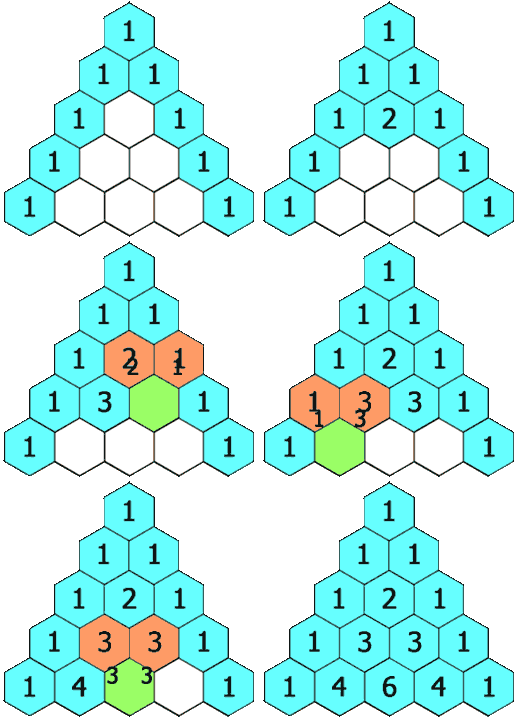
In Pascal's triangle, each number is the sum of the two numbers directly above it.

Follow up:

Could you optimize your algorithm to use only O(k) extra space?


Example 1:

Input: rowIndex = 3
Output: [1,3,3,1]

Example 2:

Input: rowIndex = 0
Output: [1]

Example 3:

Input: rowIndex = 1
Output: [1,1]

LeetCode 118. Pascal's Triangle [Easy] [C++] 解題筆記

 Given a non-negative integer numRows, generate the first numRows of Pascal's triangle.


In Pascal's triangle, each number is the sum of the two numbers directly above it.

Example:

Input: 5
Output:
[
     [1],
    [1,1],
   [1,2,1],
  [1,3,3,1],
 [1,4,6,4,1]
]

LeetCode 117. Populating Next Right Pointers in Each Node II [Medium] [C++] 解題筆記

Given a binary tree

struct Node {
  int val;
  Node *left;
  Node *right;
  Node *next;
}

Populate each next pointer to point to its next right node. If there is no next right node, the next pointer should be set to NULL.

Initially, all next pointers are set to NULL.


Follow up:

  • You may only use constant extra space.
  • Recursive approach is fine, you may assume implicit stack space does not count as extra space for this problem.


Example 1:

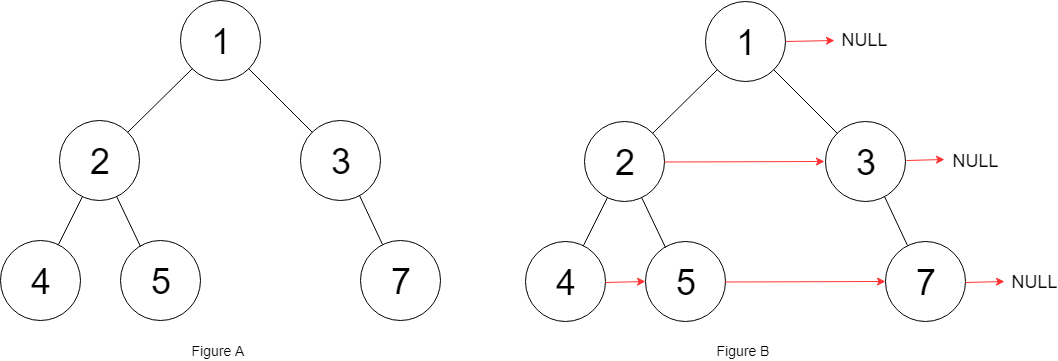
Input: root = [1,2,3,4,5,null,7]
Output: [1,#,2,3,#,4,5,7,#]
Explanation: Given the above binary tree (Figure A), your function should populate each next pointer to point to its next right node,
just like in Figure B. The serialized output is in level order as connected by the next pointers, with '#' signifying the end of each level.

2020年10月5日 星期一

LeetCode 116. Populating Next Right Pointers in Each Node [Medium] [C++] 解題筆記

You are given a perfect binary tree where all leaves are on the same level, and every parent has two children. The binary tree has the following definition:

struct Node {
  int val;
  Node *left;
  Node *right;
  Node *next;
}

Populate each next pointer to point to its next right node. If there is no next right node, the next pointer should be set to NULL.

Initially, all next pointers are set to NULL.

EX:

    Example 1:

Input: root = [1,2,3,4,5,6,7]
Output: [1,#,2,3,#,4,5,6,7,#]
Explanation: Given the above perfect binary tree (Figure A), 
your function should populate each next pointer to point to its next right node, 
just like in Figure B. The serialized output is in level order as connected by the next pointers,
with '#' signifying the end of each level.

2020年9月27日 星期日

LeetCode 115. Distinct Subsequences [Hard] [C++] 解題筆記

 這題給定兩個字串 S 和 T,要我們求 S 有多少個相異子序列等於 T。


EX:

    Input: S = "rabbbit", T = "rabbit"

    Output: 3

    Explanation:
    As shown below, there are 3 ways you can generate "rabbit" from S.
    (The caret symbol ^ means the chosen letters)

  rabbbit
    ^^^^ ^^
  rabbbit
    ^^ ^^^^
  rabbbit
    ^^^ ^^^

2020年9月16日 星期三

LeetCode 114. Flatten Binary Tree to Linked List [Medium] [C++] 解題筆記

Given a binary tree, flatten it to a linked list in-place.

For example, given the following tree:

    1
   / \
  2   5
 / \   \
3   4   6

The flattened tree should look like:

1
 \
  2
   \
    3
     \
      4
       \
        5
         \
          6

2020年9月13日 星期日

LeetCode 113. Path Sum II [Medium] [C++] 解題筆記

Given a binary tree and a sum, find all root-to-leaf paths where each path's sum equals the given sum.

Note: A leaf is a node with no children.

Example:

Given the below binary tree and sum = 22,

      5
     / \
    4   8
   /   / \
  11  13  4
 /  \    / \
7    2  5   1

Return:

[
   [5,4,11,2],
   [5,8,4,5]
]