Reverse a linked list from position m to n. Do it in one-pass.
Note: 1 ≤ m ≤ n ≤ length of list.
EX:
Input: 1->2->3->4->5->NULL, m = 2, n = 4
Output: 1->4->3->2->5->NULL
Reverse a linked list from position m to n. Do it in one-pass.
Note: 1 ≤ m ≤ n ≤ length of list.
EX:
Input: 1->2->3->4->5->NULL, m = 2, n = 4
Output: 1->4->3->2->5->NULL
Given an integer array nums, find the contiguous subarray (containing at least one number) which has the largest sum and return its sum.
EX:
Input: [-2,1,-3,4,-1,2,1,-5,4],
        Output: 6
Explanation: [4,-1,2,1] has the largest sum = 6.
The n-queens puzzle is the problem of placing n queens on an n×n chessboard such that no two queens attack each other.
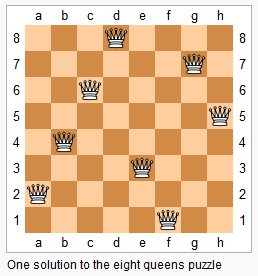
Given an integer n, return the number of distinct solutions to the n-queens puzzle.
EX:
Input: 4
    Output: 2
    Explanation: There are two distinct solutions to the 4-queens puzzle as shown below.
    [
     [".Q..",  // Solution 1
      "...Q",
      "Q...",
      "..Q."],

     ["..Q.",  // Solution 2
      "Q...",
      "...Q",
      ".Q.."]
    ]
The n-queens puzzle is the problem of placing n queens on an n×n chessboard such that no two queens attack each other.
Given an integer n, return all distinct solutions to the n-queens puzzle.
Each solution contains a distinct board configuration of the n-queens' placement, where 'Q' and '.' both indicate a queen and an empty space respectively.
EX:
Input: 4
        Output: [
         [".Q..",  // Solution 1
          "...Q",
          "Q...",
          "..Q."],

         ["..Q.",  // Solution 2
          "Q...",
          "...Q",
          ".Q.."]
        ]
Explanation: There exist two distinct solutions to the 4-queens puzzle as shown above.
Implement pow(x, n), which calculates x raised to the power n (xn).
EX:
Input: 2.00000, 10
Output: 1024.00000
Input: 2.00000, -2Output: 0.25000 Explanation: 2-2 = 1/22 = 1/4 = 0.25
這題給定一個 array 包含一些 string,要求我們將由同樣字元組成的 string 歸到同一個 array。
EX:
Input: ["eat", "tea", "tan", "ate", "nat", "bat"],
        Output:
        [
          ["ate","eat","tea"],
          ["nat","tan"],
          ["bat"]
        ]
You are given an n x n 2D matrix representing an image.
Rotate the image by 90 degrees (clockwise).
Note:
You have to rotate the image in-place, which means you have to modify the input 2D matrix directly. DO NOT allocate another 2D matrix and do the rotation.
EX:
Given input matrix =
    [
      [1,2,3],
      [4,5,6],
      [7,8,9]
    ],

    rotate the input matrix in-place such that it becomes:
    [
      [7,4,1],
      [8,5,2],
      [9,6,3]
    ]
    Output:
    [
      [1,1,2],
      [1,2,1],
      [2,1,1]
    ]
Given a collection of distinct integers, return all possible permutations.
EX:
Input: [1,2,3]
    Output:
    [
      [1,2,3],
      [1,3,2],
      [2,1,3],
      [2,3,1],
      [3,1,2],
      [3,2,1]
    ]
Given an input string (s) and a pattern (p), implement wildcard pattern matching with support for '?' and '*'.
'?' Matches any single character.
'*' Matches any sequence of characters (including the empty sequence).
The matching should cover the entire input string (not partial).
Note:
s could be empty and contains only lowercase letters a-z.p could be empty and contains only lowercase letters a-z, and characters like ? or *.s = "adceb" p = "*a*b" Output: true Explanation: The first '*' matches the empty sequence, while the second '*' matches the substring "dce".
num1 and num2 represented as strings, return the product of num1 and num2, also represented as a string. Output: "56088"
Given an unsorted integer array, find the smallest missing positive integer.
EX:
Input: [1,2,0]
Output: 3
Input: [3,4,-1,1] Output: 2 Input: [7,8,9,11,12] Output: 1
Given a collection of candidate numbers (candidates) and a target number (target), find all unique combinations in candidates where the candidate numbers sums to target.
Each number in candidates may only be used once in the combination.
Note:
target) will be positive integers.[10,1,2,7,6,1,5], target = 8,A solution set is: [ [1, 7], [1, 2, 5], [2, 6], [1, 1, 6] ]
Given a set of candidate numbers (candidates) (without duplicates) and a target number (target), find all unique combinations in candidates where the candidate numbers sums to target.
The same repeated number may be chosen from candidates unlimited number of times.
Note:
target) will be positive integers., target = 8,A solution set is: [ [2,2,2,2], [2,3,3], [3,5] ]
The count-and-say sequence is the sequence of integers with the first five terms as following:
1.     1
2.     11
3.     21
4.     1211
5.     111221
1 is read off as "one 1" or 11.
11 is read off as "two 1s" or 21.
21 is read off as "one 2, then one 1" or 1211.
Given an integer n where 1 ≤ n ≤ 30, generate the nth term of the count-and-say sequence. You can do so recursively, in other words from the previous member read off the digits, counting the number of digits in groups of the same digit.
Note: Each term of the sequence of integers will be represented as a string.
EX:
Input: 4
Output: "1211"
Explanation: For n = 3 the term was "21" in which we have two groups "2" and "1", "2" can be read as "12"
which means frequency = 1 and value = 2,
the same way "1" is read as "11", so the answer is the concatenation of "12" and "11" which is "1211".
[
  ["5","3",".",".","7",".",".",".","."],
  ["6",".",".","1","9","5",".",".","."],
  [".","9","8",".",".",".",".","6","."],
  ["8",".",".",".","6",".",".",".","3"],
  ["4",".",".","8",".","3",".",".","1"],
  ["7",".",".",".","2",".",".",".","6"],
  [".","6",".",".",".",".","2","8","."],
  [".",".",".","4","1","9",".",".","5"],
  [".",".",".",".","8",".",".","7","9"]
]
    Output: true
Given a sorted array and a target value, return the index if the target is found. If not, return the index where it would be if it were inserted in order.
You may assume no duplicates in the array.
EX:
Input: [1,3,5,6], 5
Output: 2
Given an array of integers nums sorted in ascending order, find the starting and ending position of a given target value.
Your algorithm's runtime complexity must be in the order of O(log n).
If the target is not found in the array, return [-1, -1].
EX:
Input: nums = [5,7,7,8,8,10], target = 8
Output: [3,4]
Input: nums = [5,7,7,8,8,10], target = 6
Output: [-1,-1]
Given a string containing just the characters '(' and ')', find the length of the longest valid (well-formed) parentheses substring.
EX:
Input: "(()"
Output: 2
Explanation: The longest valid parentheses substring is "()"
Input: ")()())"
Output: 4
Explanation: The longest valid parentheses substring is "()()"
Implement next permutation, which rearranges numbers into the lexicographically next greater permutation of numbers.
If such arrangement is not possible, it must rearrange it as the lowest possible order (ie, sorted in ascending order).
The replacement must be in-place and use only constant extra memory.
EX:
1,2,3 → 1,3,2
3,2,1 → 1,2,3
1,1,5 → 1,5,1
[0,9]Explanation: Substrings starting at index 0 and 9 are "barfoo" and "foobar" respectively. The output order does not matter, returning [9,0] is fine too.
Given two integers dividend and divisor, divide two integers without using multiplication, division and mod operator.
Return the quotient after dividing dividend by divisor.
The integer division should truncate toward zero, which means losing its fractional part. For example, truncate(8.345) = 8 and truncate(-2.7335) = -2.
EX:
Input: dividend = 7, divisor = -3
Output: -2
Explanation: 7/-3 = truncate(-2.33333..) = -2.
Implement strStr().
Return the index of the first occurrence of needle in haystack, or -1 if needle is not part of haystack.
EX:
Input: haystack = "hello", needle = "ll"
Output: 2 Input: haystack = "aaaaa", needle = "bba" Output: -1
Given an array nums and a value val, remove all instances of that value in-place and return the new length.
Do not allocate extra space for another array, you must do this by modifying the input array in-place with O(1) extra memory.
EX:
Given nums = [0,1,2,2,3,0,4,2], val = 2,
    Your function should return length = 5, with the first five elements of nums containing 0, 1, 3, 0, and 4.
    Note that the order of those five elements can be arbitrary.
    It doesn't matter what values are set beyond the returned length.
Given a sorted array nums, remove the duplicates in-place such that each element appear only once and return the new length.
Do not allocate extra space for another array, you must do this by modifying the input array in-place with O(1) extra memory.
EX:
Given nums = [0,0,1,1,1,2,2,3,3,4],
    Your function should return length = 5, with the first five elements of nums being modified to 0, 1, 2, 3, and 4 respectively.
    It doesn't matter what values are set beyond the returned length.
1->2->3->4->5 For k = 2, you should return: 2->1->4->3->5
For k = 3, you should return: 3->2->1->4->5
Given a linked list, swap every two adjacent nodes and return its head.
You may not modify the values in the list's nodes, only nodes itself may be changed.
EX:
Given 1->2->3->4, you should return the list as 2->1->4->3.
    [
      1->4->5,
      1->3->4,
      2->6
    ]
    Output: 1->1->2->3->4->4->5->6


