2020年10月13日 星期二

LeetCode 119. Pascal's Triangle II [Easy] [C++] 解題筆記

 Given an integer rowIndex, return the rowIndexth row of the Pascal's triangle.

Notice that the row index starts from 0.
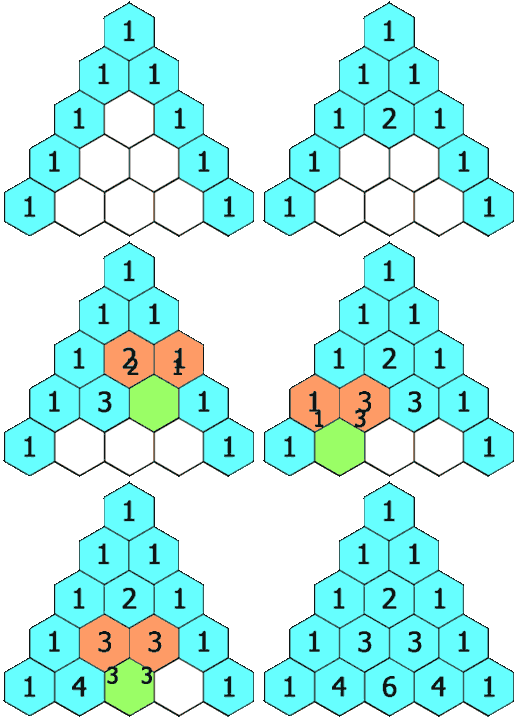

In Pascal's triangle, each number is the sum of the two numbers directly above it.

Follow up:

Could you optimize your algorithm to use only O(k) extra space?


Example 1:

Input: rowIndex = 3
Output: [1,3,3,1]

Example 2:

Input: rowIndex = 0
Output: [1]

Example 3:

Input: rowIndex = 1
Output: [1,1]

LeetCode 118. Pascal's Triangle [Easy] [C++] 解題筆記

 Given a non-negative integer numRows, generate the first numRows of Pascal's triangle.


In Pascal's triangle, each number is the sum of the two numbers directly above it.

Example:

Input: 5
Output:
[
     [1],
    [1,1],
   [1,2,1],
  [1,3,3,1],
 [1,4,6,4,1]
]

LeetCode 117. Populating Next Right Pointers in Each Node II [Medium] [C++] 解題筆記

Given a binary tree

struct Node {
  int val;
  Node *left;
  Node *right;
  Node *next;
}

Populate each next pointer to point to its next right node. If there is no next right node, the next pointer should be set to NULL.

Initially, all next pointers are set to NULL.


Follow up:

  • You may only use constant extra space.
  • Recursive approach is fine, you may assume implicit stack space does not count as extra space for this problem.


Example 1:

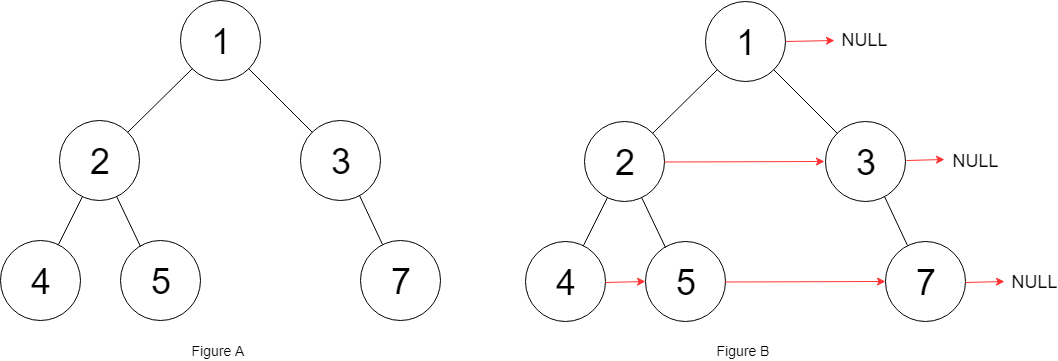
Input: root = [1,2,3,4,5,null,7]
Output: [1,#,2,3,#,4,5,7,#]
Explanation: Given the above binary tree (Figure A), your function should populate each next pointer to point to its next right node,
just like in Figure B. The serialized output is in level order as connected by the next pointers, with '#' signifying the end of each level.

2020年10月5日 星期一

LeetCode 116. Populating Next Right Pointers in Each Node [Medium] [C++] 解題筆記

You are given a perfect binary tree where all leaves are on the same level, and every parent has two children. The binary tree has the following definition:

struct Node {
  int val;
  Node *left;
  Node *right;
  Node *next;
}

Populate each next pointer to point to its next right node. If there is no next right node, the next pointer should be set to NULL.

Initially, all next pointers are set to NULL.

EX:

    Example 1:

Input: root = [1,2,3,4,5,6,7]
Output: [1,#,2,3,#,4,5,6,7,#]
Explanation: Given the above perfect binary tree (Figure A), 
your function should populate each next pointer to point to its next right node, 
just like in Figure B. The serialized output is in level order as connected by the next pointers,
with '#' signifying the end of each level.