Given the head of a linked list, return the list after sorting it in ascending order.
Follow up: Can you sort the linked list in O(n logn) time and O(1) memory (i.e. constant space)?
Example 1:
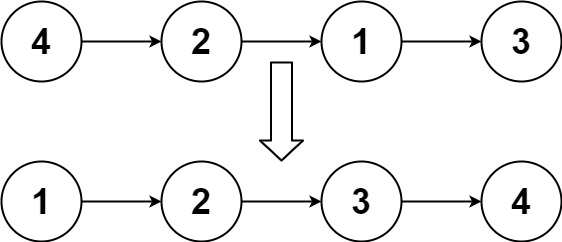
Input: head = [4,2,1,3]
Output: [1,2,3,4]
Example 2:

Input: head = [-1,5,3,4,0]
Output: [-1,0,3,4,5]
Example 3:
Input: head = []
Output: []
Constraints:
- The number of nodes in the list is in the range
[0, 5 * 104]. -105 <= Node.val <= 105
這題要我們排序一個 linked-list,並且要求在 O(nlogn) time。 要在 O(nlogn) time 完成排序自然需要利用 quick sort, heap sort, 或是 merge sort 之類的方式,但是題目同時要求要在 O(1) space 下完成排序,因此 quick sort 是利用 divide & conquer 的技巧需要 recursive 的求解因此遞迴時會用到 stack的空間最壞情況下空間複雜度會來到 O(n),而 heap sort 在過程中也需要用到 heap 空間複雜度同樣是 O(n)。因此這題最適合的是用 merge-sort buttom up 的實作方式 (top-down 也是遞迴求解因此空間複雜度為O(nlogn)) 才能達到 O(1) 的空間複雜度。
完整程式碼:
/* merge sort (top-down)
* O(nlogn) time
* O(nlogn) space (recursive)
*/
class Solution {
public:
ListNode* sortList(ListNode* head) {
// remain 0 or 1
if (head == NULL || head->next == NULL) {
return head;
}
ListNode* slow = head;
ListNode* fast = head->next;
while (fast != NULL && fast->next != NULL) {
slow = slow->next;
fast = fast->next->next;
}
ListNode* mid = slow->next;
slow->next = nullptr;
return merge(sortList(head), sortList(mid));
}
ListNode* merge(ListNode* l1, ListNode* l2) {
ListNode dummy(0);
ListNode* tail = &dummy;
while (l1 && l2) {
if (l1->val > l2->val) {
swap(l1, l2);
}
tail->next = l1;
l1 = l1->next;
tail = tail->next;
}
if (l1) { tail->next = l1; }
if (l2) { tail->next = l2; }
return dummy.next;
}
};
/* merge sort bottom up
* O(nlogn) time
* O(1) space
*/
class Solution {
public:
ListNode* sortList(ListNode* head) {
// remain 0 or 1
if (head == NULL || head->next == NULL) {
return head;
}
// compute len of list
int len = 0;
auto cur = head;
while (cur) {
cur = cur->next;
len++;
}
ListNode dummy(0);
dummy.next = head;
ListNode* left;
ListNode* right;
// record the tail of current merged sublist
ListNode* tail;
for (int n = 1; n < len; n <<= 1) {
cur = dummy.next;
tail = &dummy;
while (cur) {
left = cur;
right = split(left, n);
cur = split(right, n);
auto merged = merge(left, right);
// the head of merged sublist
tail->next = merged.first;
// the tail of merged sublist
tail = merged.second;
}
}
return dummy.next;
}
// split the list to first n element and remaining part, return the head of remaining part.
// ex: 4->2->1->3 and n = 1, then remaining part is 2->1->3
ListNode* split (ListNode* head, int n) {
while (--n && head) {
head = head->next;
}
auto remain = (head)? head->next : nullptr;
if (head) { head->next = nullptr; }
return remain;
}
// return the head after merge and tail of the merged sublist
pair<ListNode*, ListNode*> merge(ListNode* l1, ListNode* l2) {
ListNode dummy(0);
ListNode* tail = &dummy;
while (l1 && l2) {
if (l1->val > l2->val) {
swap(l1, l2);
}
tail->next = l1;
l1 = l1->next;
tail = tail->next;
}
if (l1) { tail->next = l1; }
if (l2) { tail->next = l2; }
while (tail->next) { tail = tail->next; }
return {dummy.next, tail };
}
};

沒有留言:
張貼留言