2021年2月27日 星期六

LeetCode 146. LRU Cache [Medium] [C++] 解題筆記

Design a data structure that follows the constraints of a Least Recently Used (LRU) cache.

Implement the LRUCache class:

  • LRUCache(int capacity) Initialize the LRU cache with positive size capacity.
  • int get(int key) Return the value of the key if the key exists, otherwise return -1.
  • void put(int key, int value) Update the value of the key if the key exists. Otherwise, add the key-value pair to the cache. If the number of keys exceeds the capacity from this operation, evict the least recently used key.

Follow up:
Could you do get and put in O(1) time complexity?


Example 1:

Input
["LRUCache", "put", "put", "get", "put", "get", "put", "get", "get", "get"]
[[2], [1, 1], [2, 2], [1], [3, 3], [2], [4, 4], [1], [3], [4]]
Output
[null, null, null, 1, null, -1, null, -1, 3, 4]

Explanation
LRUCache lRUCache = new LRUCache(2);
lRUCache.put(1, 1); // cache is {1=1}
lRUCache.put(2, 2); // cache is {1=1, 2=2}
lRUCache.get(1);    // return 1
lRUCache.put(3, 3); // LRU key was 2, evicts key 2, cache is {1=1, 3=3}
lRUCache.get(2);    // returns -1 (not found)
lRUCache.put(4, 4); // LRU key was 1, evicts key 1, cache is {4=4, 3=3}
lRUCache.get(1);    // return -1 (not found)
lRUCache.get(3);    // return 3
lRUCache.get(4);    // return 4

2021年2月25日 星期四

LeetCode 145. Binary Tree Postorder Traversal [Medium] [C++] 解題筆記

 Given the root of a binary tree, return the postorder traversal of its nodes' values.


Example 1:

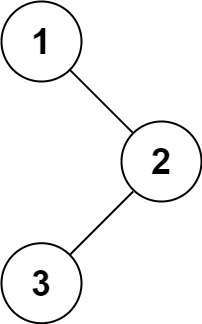
Input: root = [1,null,2,3]
Output: [3,2,1]

Example 2:

Input: root = []
Output: []

Example 3:

Input: root = [1]
Output: [1]

Example 4:

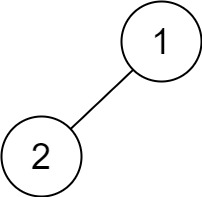
Input: root = [1,2]
Output: [2,1]

Example 5:

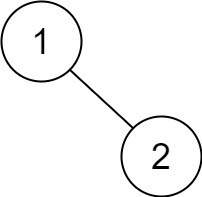
Input: root = [1,null,2]
Output: [2,1]

LeetCode 144. Binary Tree Preorder Traversal [Medium] [C++] 解題筆記

 Given the root of a binary tree, return the preorder traversal of its nodes' values.


Example 1:

Input: root = [1,null,2,3]
Output: [1,2,3]

Example 2:

Input: root = []
Output: []

Example 3:

Input: root = [1]
Output: [1]

Example 4:

Input: root = [1,2]
Output: [1,2]

Example 5:

Input: root = [1,null,2]
Output: [1,2]

LeetCode 143. Reorder List [Medium] [C++] 解題筆記

Given a singly linked list L: L0L1→…→Ln-1Ln,

reorder it to: L0LnL1Ln-1L2Ln-2→…

You may not modify the values in the list's nodes, only nodes itself may be changed.

Example 1:

Given 1->2->3->4, reorder it to 1->4->2->3.

Example 2:

Given 1->2->3->4->5, reorder it to 1->5->2->4->3.

2021年2月24日 星期三

LeetCode 142. Linked List Cycle II [Medium] [C++] 解題筆記

 這題是 141. Linked List Cycle 的進階題,除了要判斷 linked list 中是否含有 cycle 之外還必須找出 cycle 的起點。

Example 1:

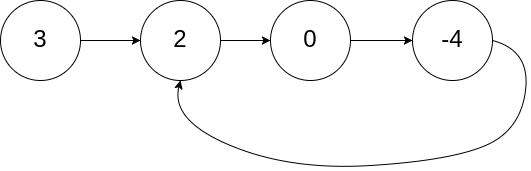
Input: head = [3,2,0,-4], pos = 1
Output: tail connects to node index 1
Explanation: There is a cycle in the linked list, where tail connects to the second node.

Example 2:

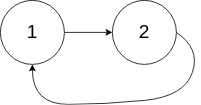
Input: head = [1,2], pos = 0
Output: tail connects to node index 0
Explanation: There is a cycle in the linked list, where tail connects to the first node.

Example 3:

Input: head = [1], pos = -1
Output: no cycle
Explanation: There is no cycle in the linked list.

2021年2月17日 星期三

LeetCode 141. Linked List Cycle [Easy] [C++] 解題筆記

這題給我們一個 Linked List 要我們判斷該 Linked List 有沒有包含環 (cycle)。

Example 1:

Input: head = [3,2,0,-4], pos = 1
Output: true
Explanation: There is a cycle in the linked list, where the tail connects to the 1st node (0-indexed).

Example 2:

Input: head = [1,2], pos = 0
Output: true
Explanation: There is a cycle in the linked list, where the tail connects to the 0th node.

Example 3:

Input: head = [1], pos = -1
Output: false
Explanation: There is no cycle in the linked list.

LeetCode 140. Word Break II [Hard] [C++] 解題筆記

 這題是 139. Word Break 的進階題,一樣給定一個 string s 和字串陣列 wordDict,但這題要求的是所有可能的解,即由 wordDict 中的字串組合成 s 的所有可能方式(wordDict 中的字串可以重複使用)。

Example 1:

Input:
s = "catsanddog"
wordDict = ["cat", "cats", "and", "sand", "dog"]
Output:
[
  "cats and dog",
  "cat sand dog"
]

Example 2:

Input:
s = "pineapplepenapple"
wordDict = ["apple", "pen", "applepen", "pine", "pineapple"]
Output:
[
  "pine apple pen apple",
  "pineapple pen apple",
  "pine applepen apple"
]
Explanation: Note that you are allowed to reuse a dictionary word.

Example 3:

Input:
s = "catsandog"
wordDict = ["cats", "dog", "sand", "and", "cat"]
Output:
[]

2021年2月16日 星期二

LeetCode 139. Word Break [Medium] [C++] 解題筆記

 這題給定一個非空的 string s 和一個字串陣列 wordDict,要你判斷 s 是否可由 wordDict 中的字串串接而成,wordDict 中的字串可重複使用。

Example 1:

Input: s = "leetcode", wordDict = ["leet", "code"]
Output: true
Explanation: Return true because "leetcode" can be segmented as "leet code".

Example 2:

Input: s = "applepenapple", wordDict = ["apple", "pen"]
Output: true
Explanation: Return true because "applepenapple" can be segmented as "apple pen apple".
             Note that you are allowed to reuse a dictionary word.

Example 3:

Input: s = "catsandog", wordDict = ["cats", "dog", "sand", "and", "cat"]
Output: false

LeetCode 138. Copy List with Random Pointer [Medium] [C++] 解題筆記

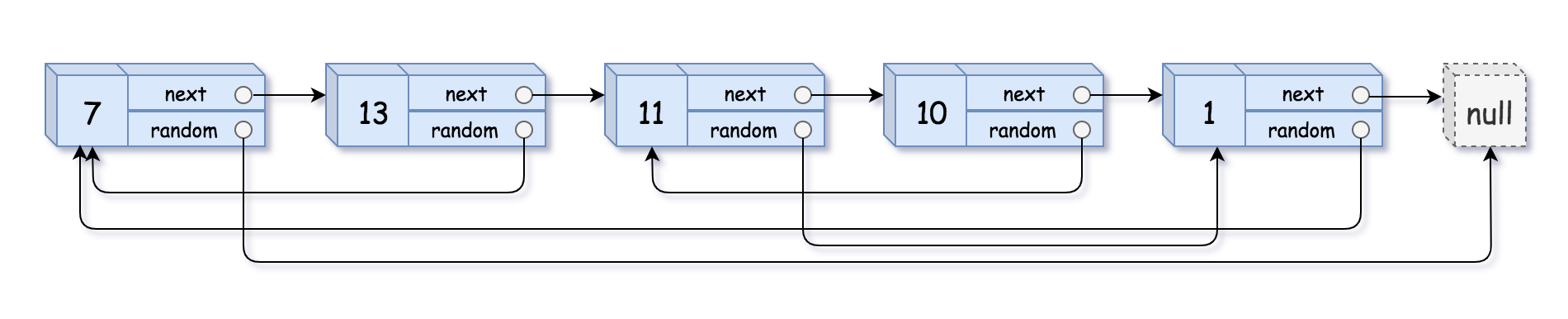
 這題給我們一個 Linked List 的串列,要我們照 deep copy 的方式將它複製一份。

Example 1:

Input: head = [[7,null],[13,0],[11,4],[10,2],[1,0]]
Output: [[7,null],[13,0],[11,4],[10,2],[1,0]]

Example 2:

Input: head = [[1,1],[2,1]]
Output: [[1,1],[2,1]]

Example 3:

Input: head = [[3,null],[3,0],[3,null]]
Output: [[3,null],[3,0],[3,null]]

Example 4:

Input: head = []
Output: []
Explanation: The given linked list is empty (null pointer), so return null.

2021年2月13日 星期六

LeetCode 137. Single Number II [Medium] [C++] 解題筆記

Given an integer array nums where every element appears three times except for one, which appears exactly once. Find the single element and return it.


Example 1:

Input: nums = [2,2,3,2]
Output: 3

Example 2:

Input: nums = [0,1,0,1,0,1,99]
Output: 99

2021年2月5日 星期五

LeetCode 136. Single Number [Easy] [C++] 解題筆記

Given a non-empty array of integers nums, every element appears twice except for one. Find that single one.

Follow up: Could you implement a solution with a linear runtime complexity and without using extra memory?


Example 1:

Input: nums = [2,2,1]
Output: 1

Example 2:

Input: nums = [4,1,2,1,2]
Output: 4

Example 3:

Input: nums = [1]
Output: 1

LeetCode 135. Candy [Hard] [C++] 解題筆記

 There are N children standing in a line. Each child is assigned a rating value.

You are giving candies to these children subjected to the following requirements:

  • Each child must have at least one candy.
  • Children with a higher rating get more candies than their neighbors.

What is the minimum candies you must give?

Example 1:

Input: [1,0,2]
Output: 5
Explanation: You can allocate to the first, second and third child with 2, 1, 2 candies respectively.

Example 2:

Input: [1,2,2]
Output: 4
Explanation: You can allocate to the first, second and third child with 1, 2, 1 candies respectively.
             The third child gets 1 candy because it satisfies the above two conditions.

2021年2月3日 星期三

LeetCode 134. Gas Station [Medium] [C++] 解題筆記

這題給定兩個矩陣 gas 與 cost 分別表示在一個環狀的道路上在第 ith 個位置有 gas[i] 的汽油,而 cost[i] 表示從第 ith 個位置移動到第 (i+1)th 個位置所需要耗費的汽油量。假設有一台車子有無限的容量可以裝汽油,那摸從哪個位置開始移動能夠走完這個環狀道路一圈並保持在每個位置的時候汽油都是夠用的?

EX:

Input: gas = [1,2,3,4,5], cost = [3,4,5,1,2]
Output: 3
Explanation:
Start at station 3 (index 3) and fill up with 4 unit of gas. Your tank = 0 + 4 = 4
Travel to station 4. Your tank = 4 - 1 + 5 = 8
Travel to station 0. Your tank = 8 - 2 + 1 = 7
Travel to station 1. Your tank = 7 - 3 + 2 = 6
Travel to station 2. Your tank = 6 - 4 + 3 = 5
Travel to station 3. The cost is 5. Your gas is just enough to travel back to station 3.
Therefore, return 3 as the starting index.

Input: gas = [2,3,4], cost = [3,4,3]
Output: -1
Explanation:
You can't start at station 0 or 1, as there is not enough gas to travel to the next station.
Let's start at station 2 and fill up with 4 unit of gas. Your tank = 0 + 4 = 4
Travel to station 0. Your tank = 4 - 3 + 2 = 3
Travel to station 1. Your tank = 3 - 3 + 3 = 3
You cannot travel back to station 2, as it requires 4 unit of gas but you only have 3.
Therefore, you can't travel around the circuit once no matter where you start.