2020年10月13日 星期二

LeetCode 117. Populating Next Right Pointers in Each Node II [Medium] [C++] 解題筆記

Given a binary tree

struct Node {
  int val;
  Node *left;
  Node *right;
  Node *next;
}

Populate each next pointer to point to its next right node. If there is no next right node, the next pointer should be set to NULL.

Initially, all next pointers are set to NULL.


Follow up:

  • You may only use constant extra space.
  • Recursive approach is fine, you may assume implicit stack space does not count as extra space for this problem.


Example 1:
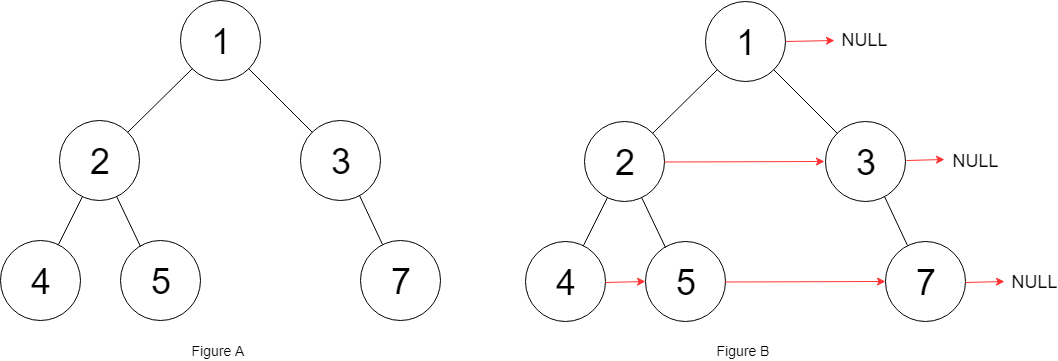
Input: root = [1,2,3,4,5,null,7]
Output: [1,#,2,3,#,4,5,7,#]
Explanation: Given the above binary tree (Figure A), your function should populate each next pointer to point to its next right node,
just like in Figure B. The serialized output is in level order as connected by the next pointers, with '#' signifying the end of each level.

2020年10月5日 星期一

LeetCode 116. Populating Next Right Pointers in Each Node [Medium] [C++] 解題筆記

You are given a perfect binary tree where all leaves are on the same level, and every parent has two children. The binary tree has the following definition:

struct Node {
  int val;
  Node *left;
  Node *right;
  Node *next;
}

Populate each next pointer to point to its next right node. If there is no next right node, the next pointer should be set to NULL.

Initially, all next pointers are set to NULL.

EX:

    Example 1:

Input: root = [1,2,3,4,5,6,7]
Output: [1,#,2,3,#,4,5,6,7,#]
Explanation: Given the above perfect binary tree (Figure A), 
your function should populate each next pointer to point to its next right node, 
just like in Figure B. The serialized output is in level order as connected by the next pointers,
with '#' signifying the end of each level.
2020年9月27日 星期日

LeetCode 115. Distinct Subsequences [Hard] [C++] 解題筆記

 這題給定兩個字串 S 和 T,要我們求 S 有多少個相異子序列等於 T。


EX:

    Input: S = "rabbbit", T = "rabbit"

    Output: 3

    Explanation:
    As shown below, there are 3 ways you can generate "rabbit" from S.
    (The caret symbol ^ means the chosen letters)

  rabbbit
    ^^^^ ^^
  rabbbit
    ^^ ^^^^
  rabbbit
    ^^^ ^^^

2020年9月16日 星期三

LeetCode 114. Flatten Binary Tree to Linked List [Medium] [C++] 解題筆記

Given a binary tree, flatten it to a linked list in-place.

For example, given the following tree:

    1
   / \
  2   5
 / \   \
3   4   6

The flattened tree should look like:

1
 \
  2
   \
    3
     \
      4
       \
        5
         \
          6

2020年9月13日 星期日

LeetCode 113. Path Sum II [Medium] [C++] 解題筆記

Given a binary tree and a sum, find all root-to-leaf paths where each path's sum equals the given sum.

Note: A leaf is a node with no children.

Example:

Given the below binary tree and sum = 22,

      5
     / \
    4   8
   /   / \
  11  13  4
 /  \    / \
7    2  5   1

Return:

[
   [5,4,11,2],
   [5,8,4,5]
]

LeetCode 112. Path Sum [Easy] [C++] 解題筆記

Given a binary tree and a sum, determine if the tree has a root-to-leaf path such that adding up all the values along the path equals the given sum.

Note: A leaf is a node with no children.

Example:

Given the below binary tree and sum = 22,

      5
     / \
    4   8
   /   / \
  11  13  4
 /  \      \
7    2      1

return true, as there exist a root-to-leaf path 5->4->11->2 which sum is 22.

2020年9月12日 星期六

LeetCode 111. Minimum Depth of Binary Tree [Easy] [C++] 解題筆記

Given a binary tree, find its minimum depth.

The minimum depth is the number of nodes along the shortest path from the root node down to the nearest leaf node.

Note: A leaf is a node with no children.

Example:

Given binary tree [3,9,20,null,null,15,7],

    3
   / \
  9  20
    /  \
   15   7

return its minimum depth = 2.

2020年9月9日 星期三

LeetCode 110. Balanced Binary Tree [Easy] [C++] 解題筆記

Given a binary tree, determine if it is height-balanced.

For this problem, a height-balanced binary tree is defined as:

a binary tree in which the left and right subtrees of every node differ in height by no more than 1.


Example 1:

Given the following tree [3,9,20,null,null,15,7]:

    3
   / \
  9  20
    /  \
   15   7

Return true.

Example 2:

Given the following tree [1,2,2,3,3,null,null,4,4]:

       1
      / \
     2   2
    / \
   3   3
  / \
 4   4

Return false.

LeetCode 109. Convert Sorted List to Binary Search Tree [Medium] [C++] 解題筆記

Given the head of a singly linked list where elements are sorted in ascending order, convert it to a height balanced BST.

For this problem, a height-balanced binary tree is defined as a binary tree in which the depth of the two subtrees of every node never differ by more than 1.


Example 1:

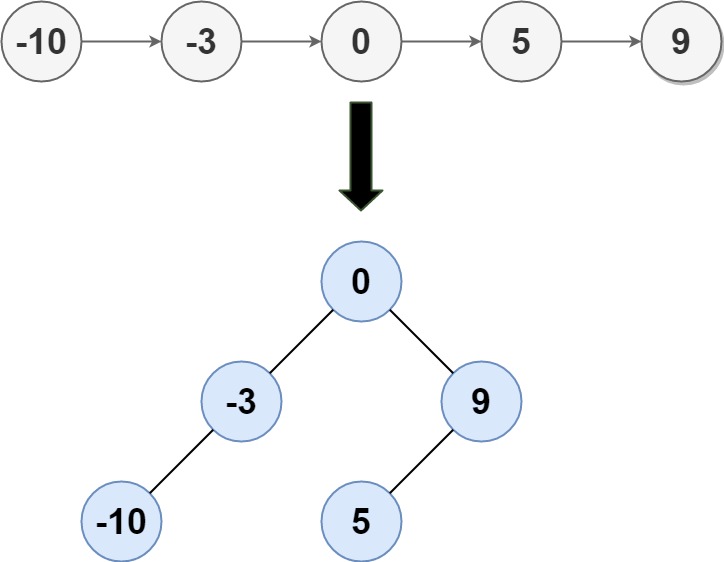
Input: head = [-10,-3,0,5,9]
Output: [0,-3,9,-10,null,5]
Explanation: One possible answer is [0,-3,9,-10,null,5], which represents the shown height balanced BST.

Example 2:

Input: head = []
Output: []

Example 3:

Input: head = [0]
Output: [0]

Example 4:

Input: head = [1,3]
Output: [3,1]


Constraints:

  • The number of nodes in head is in the range [0, 2 * 104].
  • -10^5 <= Node.val <= 10^5

2020年9月6日 星期日

LeetCode 108. Convert Sorted Array to Binary Search Tree [Easy] [C++] 解題筆記

Given an array where elements are sorted in ascending order, convert it to a height balanced BST.

For this problem, a height-balanced binary tree is defined as a binary tree in which the depth of the two subtrees of every node never differ by more than 1.

Example:

Given the sorted array: [-10,-3,0,5,9],

One possible answer is: [0,-3,9,-10,null,5], which represents the following height balanced BST:

      0
     / \
   -3   9
   /   /
 -10  5

LeetCode 107. Binary Tree Level Order Traversal II [Easy] [C++] 解題筆記

Given a binary tree, return the bottom-up level order traversal of its nodes' values. (ie, from left to right, level by level from leaf to root).

For example:
Given binary tree [3,9,20,null,null,15,7],

    3
   / \
  9  20
    /  \
   15   7

return its bottom-up level order traversal as:

[
  [15,7],
  [9,20],
  [3]
]

2020年9月5日 星期六

LeetCode 104. Maximum Depth of Binary Tree [Easy] [C++] 解題筆記

Given a binary tree, find its maximum depth.

The maximum depth is the number of nodes along the longest path from the root node down to the farthest leaf node.

Note: A leaf is a node with no children.

Example:

Given binary tree [3,9,20,null,null,15,7],

    3
   / \
  9  20
    /  \
   15   7

return its depth = 3.

LeetCode 103. Binary Tree Zigzag Level Order Traversal [Medium] [C++] 解題筆記

Given a binary tree, return the zigzag level order traversal of its nodes' values. (ie, from left to right, then right to left for the next level and alternate between).

For example:
Given binary tree [3,9,20,null,null,15,7],

    3
   / \
  9  20
    /  \
   15   7

return its zigzag level order traversal as:

[
  [3],
  [20,9],
  [15,7]
]